Aligarh
Muslim University (AMU), located in the historic city of Aligarh, Uttar
Pradesh, is a towering pillar of India’s educational landscape. Evolving from a
pioneering 19th-century reform movement into a modern public research
university, AMU holds a distinct status as an Institute of National Importance
under the Seventh Schedule of the Indian Constitution.
With a
sprawling campus covering 1,155 acres, it is a bustling academic metropolis
that houses thousands of students and teaching staff. However, AMU is far more
than its impressive statistics; it is the physical manifestation of a profound
vision to harmonize traditional values with modern scientific education. While
rooted in the cultural heritage of Indian Muslims, the university has
maintained an unwavering commitment to inclusivity, keeping its doors open to
students from all communities, castes, and nationalities since its inception.
The Roots: Sir Syed Ahmad Khan and the Aligarh Movement
The story
of AMU cannot be told without understanding the monumental efforts of its
founder, Sir Syed Ahmad Khan. He was a visionary social reformer who
recognized that the empowerment of the Indian Muslim populace—and Indians at
large—depended heavily on modern education. Following the socio-economic shifts
of the late 19th century, Sir Syed sought a radical solution. Inspired by his
visits to the University of Oxford and the University of Cambridge, he aimed to
build an institution that mirrored the rigorous academic structure of the
British education system while preserving indigenous ethical values.
This led
to the establishment of the Muhammadan Anglo-Oriental (MAO) College in 1875.
The founding of MAO College was the cornerstone of the Aligarh Movement, a
wider cultural and educational renaissance. Sir Syed’s vision transcended
religious boundaries, which was evident in the widespread support the college
received. Initial funding poured in not just from prominent Muslim leaders like
the Nizam of Hyderabad (who donated a remarkable ₹5,00,000 in 1918), but also
from Hindu rulers, including the Maharaja of Patiala (₹58,000) and the Raja of
Banaras (₹60,000), reflecting a collective national investment in the
institution's future.
From College to University: The Transformation of
1920
For over
four decades, MAO College functioned as a premier affiliate college, initially
under the University of Calcutta and later Allahabad University. However, the
ultimate goal was always to establish an independent university. By the early
1900s, the Muslim University Association was formed to spearhead this
transition.
When the
Government of India stipulated that a sum of thirty lakh rupees was required to
establish the university, a massive fundraising campaign was launched. Leaders
like Mohammad Ali Mohammad Khan and Aga Khan III played pivotal roles in
mobilizing resources from both Muslims and non-Muslims across the subcontinent.
Their efforts bore fruit when the Aligarh Muslim University Act was passed in
1920, officially elevating MAO College to the status of a full-fledged central
university.
Architectural Marvels and Campus Infrastructure
Walking
through the AMU campus is akin to taking a journey through architectural
history. The university is celebrated for its breathtaking structural design,
which seamlessly blends Islamic architectural elements with colonial and
traditional Indian styles.
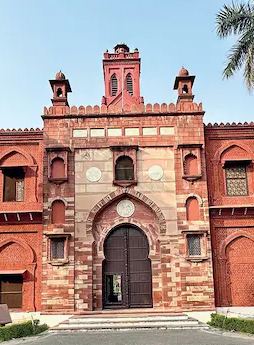
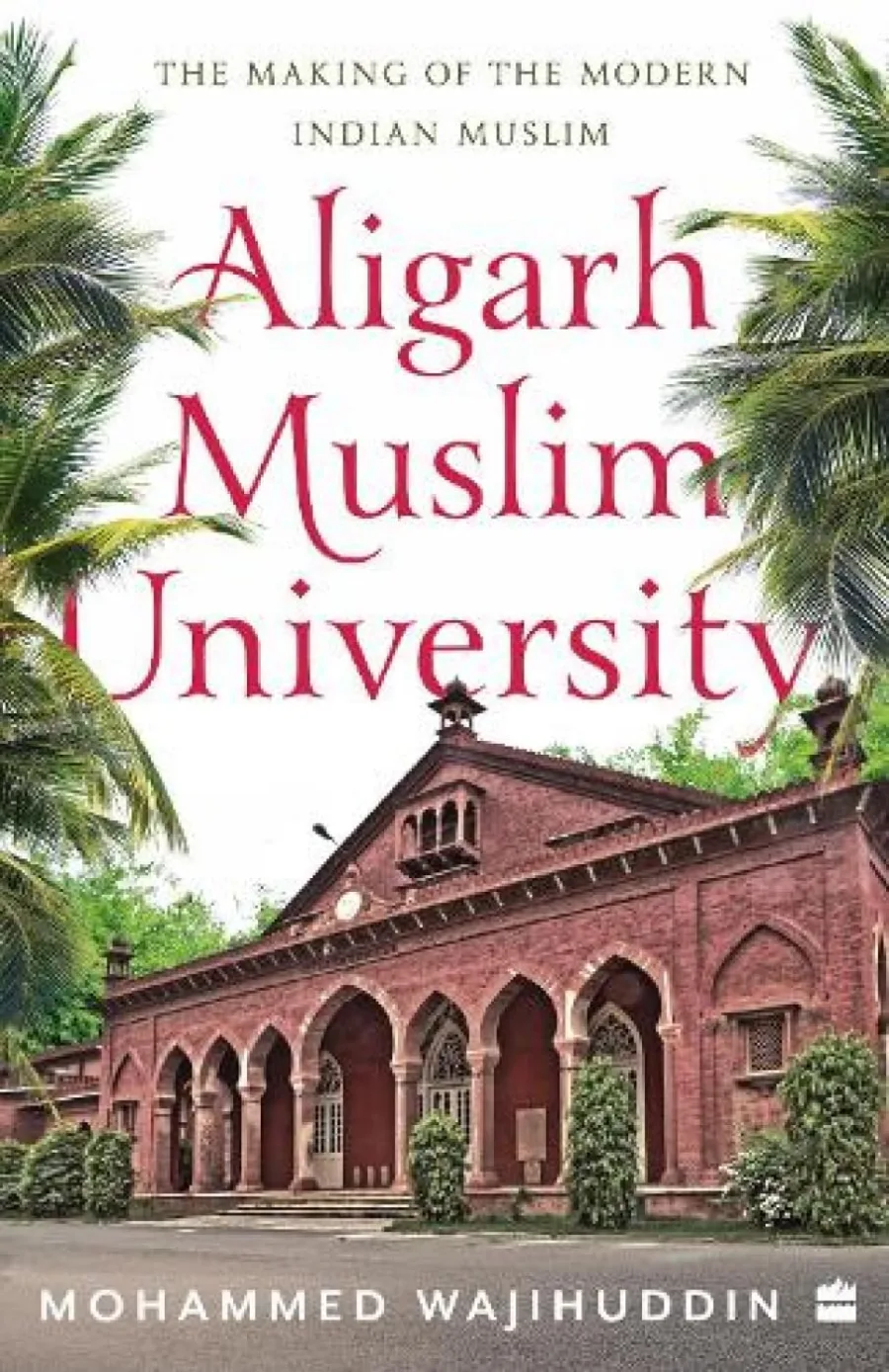
The iconic red-brick structures and white domes define the visual identity
of the university's 1,155-acre urban campus.
At the heart of the campus lies Strachey Hall, one of
the oldest and most iconic structures, standing as a testament to the university's
rich heritage. Adjacent to it, the Jama Masjid of AMU, with its pristine white
domes and elegant minarets, forms the spiritual and visual anchor of the
campus. Beyond its historical buildings, the campus is heavily forested and
features wide boulevards, meticulously manicured lawns, and state-of-the-art
academic blocks.
Academic Framework and Extensive Course Offerings
Today, AMU is an academic
powerhouse that caters to almost every conceivable discipline. The university is organized into 13 major
faculties—including Medicine, Engineering, Sciences, Humanities, Law, and
Theology—which encompass 117 teaching departments.
It offers over 300 distinct degrees, ranging from
traditional undergraduate programs to advanced doctoral research and vocational
diplomas.
AMU is home to several prestigious constituent
colleges:
· Jawaharlal Nehru Medical College (JNMC): Established in 1962, it is attached to a massive 1,024-bed
teaching hospital that provides crucial healthcare services while training
top-tier medical professionals,.
· Zakir Husain College of Engineering and Technology: Founded in 1935, it is renowned for a rigorous,
project-based curriculum that encourages students to design solutions for the
underprivileged,.
· Ajmal Khan Tibbiya College: Established
in 1927, it remains one of the premier institutions in India for the study and
practice of Unani medicine.
Research Excellence and Global Rankings
AMU’s commitment to
academic rigor is reflected in its consistent performance in national and
international rankings. Under the National
Institutional Ranking Framework (NIRF), AMU frequently secures a spot among the
top 10 universities in India.
Globally, it maintains a strong presence, typically
placing in the 601–800 band of the prestigious Times Higher Education (THE)
World University Rankings.
The university is
particularly noted for its robust research output in the STEM fields. Departments focusing on Biology, Radiochemistry, and
Engineering have garnered international recognition.
With over 32,000 academic publications and roughly
620,000 citations attributed to its researchers, AMU operates not just as a
teaching institution, but as a critical hub for scientific inquiry and
technological innovation.
A Unique Residential Character
One of the most defining
features of Aligarh Muslim University is its vibrant residential life. Unlike
many modern day-scholar universities, AMU was designed to be a fully immersive
residential community, a concept Sir Syed borrowed directly from his
observations in England. Today, the majority of the
university’s 18,000+ students and staff live on campus,.
The
residential system is organized into 19 distinct Halls of Residence, which
collectively manage over 80 hostels.
These halls are not just dormitories; they are the epicenters of student life,
culture, and governance. Each hall has its own dining traditions, reading
rooms, sports facilities, and cultural festivals. This close-knit living
arrangement fosters a profound sense of brotherhood and sisterhood among
students who come from every Indian state and nations across Africa, West Asia,
and Southeast Asia.
Off-Campus Centers and National Reach
While AMU is inextricably
linked to the city of Aligarh, its educational mission has expanded beyond the
borders of Uttar Pradesh. In 2011, recognizing the need
to provide high-quality education in historically underserved regions, AMU
established two major satellite campus centers: one in Malappuram (Kerala) and
another in Murshidabad (West Bengal).
These
centers focus on specialized professional courses, notably offering programs in
Business Management (MBA) and Integrated Law,.
By establishing these campuses, AMU has successfully broadened its national
footprint, providing students in South and East India with direct access to its
historic academic legacy.
Illustrious Alumni: Shaping the World
The true measure of any university lies in the impact
of its alumni, and the graduates of AMU—affectionately known as
"Aligs"—have left an indelible mark globally. The university has been
a cradle for national leaders, intellectuals, and artists.
Its alumni roster is extraordinary:
· National Leaders: Former Presidents of India like Dr.
Zakir Husain, and former Vice President Mohammad Hamid Ansari.
· Global Statesmen: Mansoor Ali
(former Prime Minister of Bangladesh) and Mohamed Amin Didi (former President
of the Maldives).
· Cultural Icons: In the realm
of arts and cinema, legends like actor Naseeruddin Shah and lyricist Javed
Akhtar honed their crafts at AMU.
· Freedom Fighters: It counts
among its ranks Khan Abdul Ghaffar Khan, the legendary independence activist
and recipient of the Bharat Ratna.
Over a century and a half since its modest beginnings as a small college,
Aligarh Muslim University stands as a triumphant realization of Sir Syed Ahmad
Khan’s vision. Its motto, Taught man what he knew not (derived from the
Qur'an), perfectly encapsulates its mission of continuous discovery and enlightenment.
AMU remains a unique experiment in Indian education—a
place that proudly embraces its heritage while championing scientific temper
and modern research. By continually updating its curriculum to meet the demands
of the modern world, fostering a deeply inclusive residential community, and
driving high-impact research, Aligarh Muslim University ensures that it is not
merely a monument to the past, but a dynamic engine driving the future of
higher education.